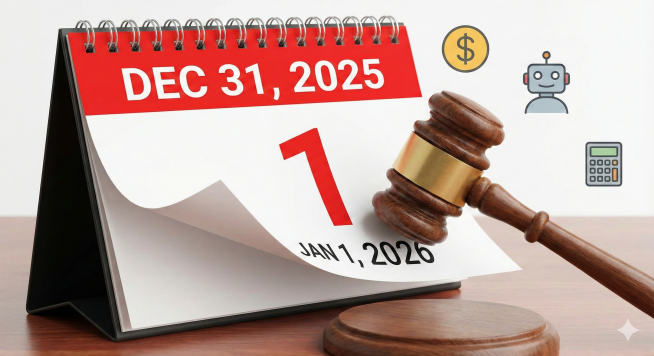
Let’s be honest: the week between Christmas and New Year’s is usually a blur of leftovers and procrastination. But while we’re all trying to avoid checking our emails, the government has been busy. When the calendar flips next week, a whole slate of new laws 2026 is going to hit the books, and unlike those New Year’s resolutions we mostly ignore, these are actually mandatory.
It’s not just the usual boring administrative stuff, either. This year feels different. We aren’t just talking about minor tweaks; we’re looking at changes that actually touch your daily life—from how much social security lands in your bank account to how AI is allowed to treat you when you apply for a job.
We did the heavy lifting and combed through the legislative fine print so you don’t have to. Here are the five big changes coming down the pipe that you need to know about before you wake up on January 1st.

1. Social Security is Getting a Raise (But Is It Enough?)
For the 71 million folks relying on Social Security, the first bit of news is mostly good. The Social Security Administration (SSA) confirmed we are getting a 2.8% Cost-of-Living Adjustment (COLA) starting in January. This is one of the most talked-about new laws 2026 brings to the table.
The Real-World Impact
Is it a fortune? No. But it helps.
- The Numbers: The average retiree is going to see about $56 extra a month. That bumps the average check up to around $2,071.
- The Timing: If you’re on SSI, keep an eye on your account—payments are actually dropping on December 31st because of the holiday schedule.
The “But” Factor: Before you spend that extra cash, remember healthcare costs are creeping up too. Medicare Part B premiums are projected to hit $202.90 next year. It’s a bit of a “give and take” situation. You can double-check your exact numbers on the <a href=”https://www.ssa.gov/cola/” target=”_blank” rel=”noopener”>SSA website</a>.
2. The Crackdown on “Robot Recruiters”
We spent all of 2025 hyping up AI, and it looks like 2026 is the year we finally put some guardrails on it. One of the most interesting new laws 2026 introduces is a ban on “Algorithmic Discrimination.”
What’s Happening in Illinois and California?
Starting January 1, states like Illinois and California are drawing a line in the sand. It’s basically becoming illegal for companies to use AI software that automatically filters out job applicants based on biased data—like where you live or how old the system thinks you are.
- If you’re hunting for a job: This is huge. It means there’s a better chance a real human being actually reads your resume instead of a bot tossing it in the digital trash can.
- If you’re the boss: Time to audit your software. The “set it and forget it” days of hiring are over.
3. Minimum Wage is Jumping in 20+ States
The federal minimum wage is still sitting at $7.25 (same as it has been for ages), but the states aren’t waiting around for Washington. As part of the new laws 2026 rollout, more than 20 states are triggering automatic wage hikes on New Year’s Day.
- California: Fast food workers are seeing another bump, keeping up the momentum from 2024.
- The East Coast: New York and New Jersey are inching their way closer to that $16-$17/hour range.
- The Bottom Line: If you run a small business, double-check your payroll settings before New Year’s Eve. The last thing you want is a fine for underpaying staff on the very first payday of the year.
4. The Tax Cliff “Will They/Won’t They” Drama
If you read our post on the <a href=”https://usanewscycle.com/tcja-expiration-2025-tax-cliff-update” target=”_self”>2025 Tax Cliff</a>, you know this is the elephant in the room. The expiration of the Trump tax cuts is looming large.
Technically, if Congress doesn’t get its act together in the next week, the new laws 2026 will effectively default us back to the 2017 tax brackets.
- Why it matters: Your paycheck withholding could look different in January.
- The Headache: If the standard deduction gets cut in half, we are all going to have to start saving receipts in shoeboxes again to itemize. Let’s hope they cut a deal before the ball drops.
5. Pay Transparency is Basically National Now
Remember when asking about salary was taboo? Those days are gone. What started in Colorado and NYC has snowballed. Legislation taking effect in several states in 2026 forces companies to list salary ranges right on the job posting.
Here is the kicker: even if your state doesn’t have this law yet, you’ll probably still see the benefits. Because remote work makes hiring national, most big companies are just adopting these new laws 2026 standards across the board to save themselves the legal headache.
- Prediction: By the end of next year, a job posting without a salary range is going to look like a massive red flag.
Conclusion: Get Ready for Jan 1
Moving into 2026 is more than just changing the date on your checks (do people still write checks?). It’s a shift in the rules of the game. From the 2.8% COLA bump to getting treated fairly by AI, these new laws 2026 are the government’s way of trying to keep up with a weird, fast-moving economy. “To stay updated on how these changes affect the economy, follow our latest Business news coverage.”
So, while you’re finishing up the holiday leftovers, maybe take five minutes to check your pay stubs and benefits. It pays to pay attention.
Disclaimer: We aren’t lawyers or financial advisors, just news junkies. Laws change depending on where you live, so talk to a pro if you’re worried about your specific situation.