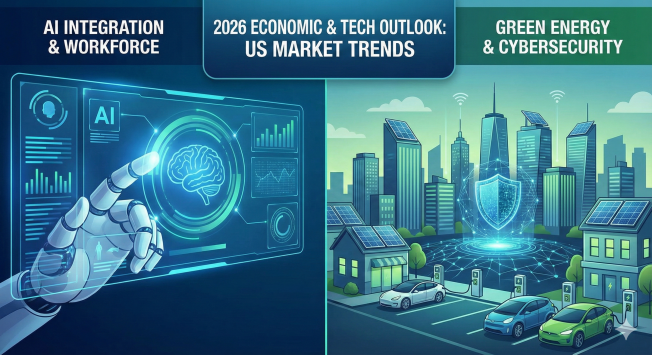
As 2025 comes to an end, Americans are looking ahead with a mix of cautious hope and strategic curiosity. In the last year, there have been a lot of changes in policies, new technologies, and corrections in the market. Now that the dust has settled, the top 2026 economic trends are becoming clear.
Families, small business owners, and investors need to know where the market is going. It’s no longer a luxury. The “wait and see” time is over. The economy is moving into a new phase of integrating technology and making things locally.
We looked at the most recent data, federal reports, and market signals to put together the most complete guide to the 2026 economic trends that will affect your job, your wallet, and your future.
1. The AI Integration Phase: From Hype to Utility
2024 was the year of discovery, 2025 was the year of experimentation, and 2026 will be the year of integration. We’re moving past the novelty of simple chatbots and into a time when AI is the “nervous system” for big businesses.
Workforce Shifts and 2026 Economic Trends
The fear of “robots taking jobs” is now being replaced by the reality of “AI-augmented” jobs. According to data projections similar to those from the <a href=”https://www.bls.gov/” target=”_blank” rel=”noopener”>Bureau of Labor Statistics</a>, proficiency with AI tools will be a standard requirement for white-collar roles. One of the defining 2026 economic trends will be the surge in demand for “AI Ethics Officers” and “Prompt Engineers.”
- Impact on Customers: You will see AI taking on more difficult customer service tasks. Instead of annoying phone trees, you can expect voice agents that sound like real people.
- Investor Insight: The “Gold Rush” for chipmakers may calm down, but the real growth opportunity in these 2026 economic trends lies in software infrastructure—companies that build the secure “pipes” for data.
2. The Green Energy Grid Makeover
The “energy independence” story has become the most important one in Washington. One of the most critical 2026 economic trends is the push to protect the US from unstable global oil markets.
It’s not just about solar panels; it’s also about the Smart Grid. The US power grid is getting a huge facelift to handle the extra load from data centers. You can read more about grid modernization at the <a href=”https://www.energy.gov/” target=”_blank” rel=”noopener”>Department of Energy</a> website.
- The EV Market Stabilization: After a rough year in 2025, the Electric Vehicle market is expected to grow up. This stabilization is a key part of positive 2026 economic trends.
- Effect on Consumers: Homeowners should keep an eye out for new tax credits. As extreme weather makes the grid less reliable, becoming “energy resilient” is a smart move.
3. Cybersecurity as a Top Priority
The threat landscape is growing at an alarming rate. Big companies used to think of cybersecurity as just an IT issue, but now it is a personal economic priority and a major factor in 2026 economic trends.
The biggest threat in 2026 won’t be a hacker in a basement; it will be cybercrime powered by AI.
- “Zero Trust” is becoming more popular: This security model says that nothing inside or outside the network is safe.
- What this means for consumers: Online verification will be stricter. To stop the flood of deepfake bots, you may soon need to show your government ID to open a new bank account.
4. The Housing Market: A “Soft Correction”
The question on the minds of all potential homebuyers is still, “Will prices finally drop?” Analyzing 2026 economic trends in real estate suggests that while a crash is unlikely, a “soft correction” is expected.
The Change in Location
The gap between “Tier 1” cities (like New York) and “Tier 2” boom towns (like Nashville) will keep getting bigger. This geographic shift is one of the most visible 2026 economic trends.
- Inventory Levels: As interest rates stabilize, the “lock-in effect” will start to go away. This will add more inventory to the market.
- The Rental Outlook: Rents are expected to level off in big cities due to a surplus of luxury apartments.
- Investor Insight: The smart money is looking at multi-family housing in the Sun Belt region.
5. The Return of “Made in USA” (Reshoring)
The huge effort to bring jobs back to the US is probably the most important long-term trend. The vulnerabilities exposed by supply chain failures have forced US companies to bring manufacturing back home. This “reshoring” effort is central to the 2026 economic trends we are monitoring.
Independence in Strategy
We expect to see the real benefits of investments made in the semiconductor industry. For a deeper look at how government policy is driving this, read our analysis on the Trump White House Address Highlights.
Areas to Keep an Eye On:
- Semiconductors: Making it less necessary to get chips from Asia.
- Advanced Batteries: Necessary for the transition to clean energy.
- Biotech: Making sure the US has its own supply of important drugs.
Conclusion: How to Get Through the Next Year
The year 2026 will be a time of stability and technological growth. We are moving away from the shockwaves of the pandemic and into a new economic reality. By keeping an eye on these 2026 economic trends, you can better prepare for the future.
There are still problems to solve, especially when it comes to finding a balance between growth and the cost of living. However, there are many opportunities for those who stay informed. Being flexible will be the key to success in 2026.